Review · updated August 5, 2026
Honeydue review: the couples app that gets sharing right
Six connected accounts, 386 transactions, two school payments, and 42 days at our kitchen table.
Our verdict: Honeydue is the best budgeting app for most couples in 2026, earning 4.8/5 after our 42-day test. It makes shared spending visible without forcing partners to merge every account. Planning tools are lighter than Goodbudget or YNAB, but the free price, flexible privacy, and conversation-friendly transaction feed make it unusually easy to keep using.
What worked
- Each partner controls what is shared
- Clear joint transaction feed and comments
- Useful bill reminders
- Core experience is free
What did not
- Budget planning is fairly basic
- No full desktop workspace
- Occasional delayed institution updates
- Reporting lacks deep trend controls
Why Honeydue is our number-one pick
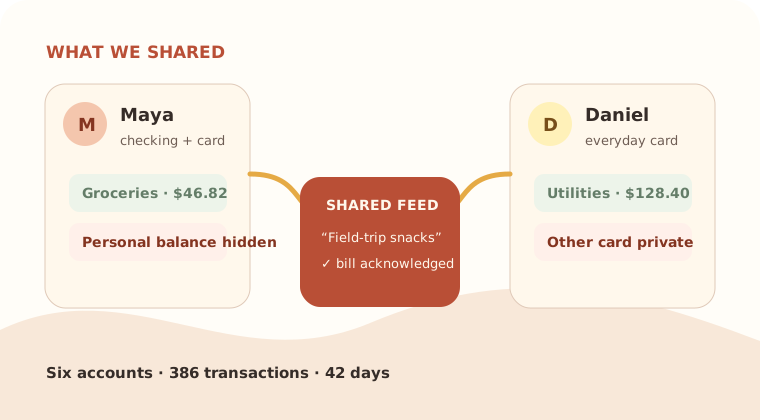
Most household budget apps begin with arithmetic. Honeydue begins with the relationship: what should we both see, what stays private, and where can we talk about a purchase without turning dinner into an audit? During our test, Maya shared the household checking account and one credit card, while Daniel shared his everyday card but hid its balance. Both could see the joint bills. That setup took less than fifteen minutes and felt closer to real couple finances than an all-or-nothing dashboard.
The shared feed was the feature we used most. A $46.82 supermarket transaction could carry a quick note—“included field-trip snacks”—so the other person had context before questioning the grocery category. Partners can react or comment inside the transaction rather than rebuilding the story later. That sounds small, but it removed several low-grade money conversations from our week. Honeydue does not solve disagreement; it puts the relevant number and explanation in the same place.
How we tested Honeydue
We installed the public iOS and Android apps on June 10, 2026 and used them daily through July 21. We connected six accounts across two adults: two checking accounts, three credit cards, and one savings account. Our 386-transaction sample included utilities, groceries, school expenses, transfers, refunds, a tip adjustment, and one duplicate pending charge.
Every three days, we compared the app against account records and receipts. We measured whether transactions arrived, whether categories made sense, how quickly a partner could understand cash flow, and how much cleanup was required. We also tested sharing controls, comments, custom categories, bill reminders, and a week in which only one partner opened the app.
| Category | Weight | Score | Weighted points |
|---|---|---|---|
| Everyday couple usability | 30% | 4.9/5 | 1.47 |
| Tracking and sync reliability | 25% | 4.7/5 | 1.18 |
| Sharing and privacy controls | 20% | 4.9/5 | 0.98 |
| Planning and reporting | 15% | 4.2/5 | 0.63 |
| Value and data practices | 10% | 5.0/5 | 0.50 |
| Total | 100% | Rounded | 4.8/5 |
Daily use: excellent visibility, modest planning
Honeydue's home view gives both partners a readable snapshot rather than a wall of ratios. Balances, recent activity, and upcoming bills are close at hand. Custom categories handled school fees and children's activities. Trim notifications during setup, or a busy grocery weekend can make the app feel nosy.
Bank updates were dependable, though not instantaneous. Most posted transactions appeared on the next refresh cycle; one credit union lagged for roughly a day twice. Do not treat an aggregator-backed app as a live bank ledger. If a payment must clear today, check the bank itself.
The main limitation is forward planning. Honeydue can budget by category, but it lacks YNAB's “give every dollar a job” ritual or Goodbudget's explicit envelope funding. Reports favor an understandable overview over deep analysis. Couples modeling annual costs, carrying category balances, or studying long trends may outgrow it.
Honeydue price and value in 2026
Honeydue is free to download and use as of August 5, 2026. The official Honeydue website describes it as free, and we encountered no required subscription during testing. That gives it a decisive value advantage over YNAB at $109 per year and paid household dashboards near $100 annually. Free does not excuse weak software; here, it removes a recurring cost from an already capable couples tool.
Value also depends on fit. A single user gains little from Honeydue's best feature—the partner layer. A meticulous forecasting household may save more time with a paid planner. But for two people who need a shared view, bill coordination, and respectful privacy controls, Honeydue delivers the most important work at no direct cost. Our later eight-week family Honeydue diary shows what happened after the formal review, including the three disagreements the app could document but not solve.
Who should use it—and who should not
Choose Honeydue if you and a partner split bills, maintain a mix of joint and separate accounts, or keep asking each other whether a payment happened. It is especially good for couples starting financial coordination because the app does not demand a total merger or a complex budgeting doctrine on day one.
Skip it if you are budgeting alone, need a desktop-first experience, or want detailed zero-based planning. Goodbudget is the better digital-envelope system; our Goodbudget review explains the trade-off. For the direct category battle, see Honeydue vs. Goodbudget. Readers comparing a wider field should start with our six-app ranking.
Honeydue FAQ
Is Honeydue really free in 2026?
Yes. Honeydue's core couples-budgeting app is free to download and use as of August 5, 2026. We encountered no subscription wall during our 42-day test. Pricing and availability can change, but couples can currently connect accounts, choose what to share, review transactions, and track bills without a required monthly fee.
Can unmarried couples use Honeydue?
Yes. Honeydue is designed for any two people who want to coordinate money; marriage is not required. Each partner creates a login and decides which account balances and transactions the other can see. That makes it workable for partners combining everything, splitting only household bills, or keeping most finances separate.
Does Honeydue move or control my money?
The budgeting side primarily displays linked account information and helps couples discuss transactions and bills; connecting an account does not give your partner permission to spend from it. Honeydue has offered separate banking features, so read the terms for any financial account you choose to open rather than treating every feature as identical.
Who should choose Goodbudget instead?
Choose Goodbudget if your priority is planning every dollar into digital envelopes before you spend it. Honeydue is stronger for seeing and discussing what two people already did across connected accounts. Goodbudget demands more deliberate input, but that structure can be exactly what a cash-envelope household wants.