Case study · August 5, 2026
School-fee season: the September costs nobody warns you about
The expensive part was not one dramatic bill. It was eleven ordinary ones arriving together.
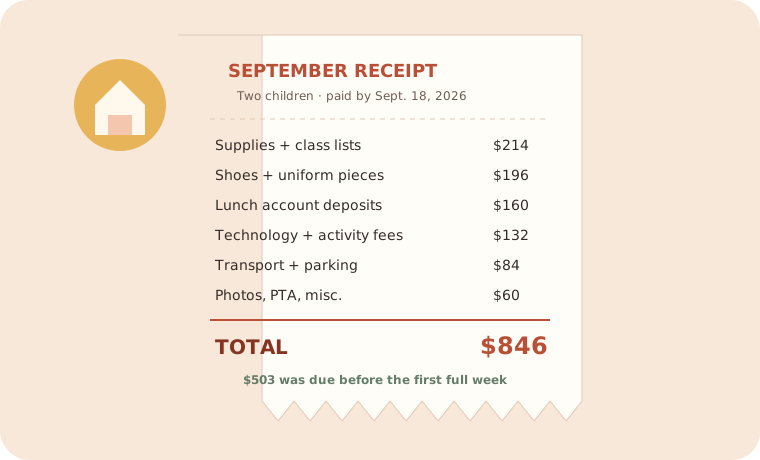
Our September 2026 school start cost $846 for two children, and $503 was due before the first full week. Supplies were only one quarter of the bill. Uniform replacements, lunch deposits, technology charges, transport, photos, and “optional” contributions created the squeeze. Next year we will save $75 monthly from October through August.
The first email understated the job
On August 3, 2026, the supply lists looked manageable: notebooks, pencils, folders, tissues, and a calculator. The list prices totaled roughly $118. By August 16, subject-specific additions and a required set of headphones had pushed supplies to $214. Buying store brands saved $31, but three exact-size binders and the calculator were unavailable at the cheapest store.
School shopping advice often treats the list as the event. Our receipts show it was the opening act. One child needed $74 in uniform pieces and $58 shoes; the other could reuse most clothing but needed $64 in shoes. We bought no decorative backpack, novelty lunch box, or first-day outfit. The $196 clothing line was replacement, not reinvention.
The charges that arrived through portals
On August 24, the online school accounts opened. Technology and activity fees totaled $132: a $45 device-protection charge, $32 in grade-level materials, $35 for laboratory and arts consumables, and a $20 student activity fee. Each amount looked small on its own. Together they exceeded the first supply-list estimate.
We also loaded $80 per child into lunch accounts. That $160 is prepaid food rather than a fee, but it still leaves checking in September. Excluding it would make the school-season budget look tidier and the bank balance no healthier. Our rule is to record cash timing and later classify consumption.
| Category | Child 1 | Child 2 | Total |
|---|---|---|---|
| Supplies and class lists | $126 | $88 | $214 |
| Shoes and uniform pieces | $132 | $64 | $196 |
| Lunch account deposits | $80 | $80 | $160 |
| Technology and activity fees | $77 | $55 | $132 |
| Transport and parking | $42 | $42 | $84 |
| Photos, PTA, and miscellaneous | $37 | $23 | $60 |
| Total | $494 | $352 | $846 |
The $144 tail after school started
We thought the spending ended on the first day. It did not. A bus-card setup and two weeks of backup car pickup cost $84 by September 18. Photo deposits, a PTA contribution, locker supplies, and two replacement water bottles added $60. We declined the premium photo package and one branded fundraiser item, so the number could easily have crossed $900.
“Optional” deserves careful reading. The $20 PTA contribution was genuinely optional, and we chose it. A device-protection fee may technically be declined but leaves a family exposed to a larger replacement cost. We labeled each charge required, practical, or discretionary before paying. That prevented us from treating every portal button as equally urgent.
What our budget got wrong
We had $400 in a school sinking fund on August 1. That was based on supplies and clothes from the prior year, not a complete review. We paid the remaining $446 from August cash flow, which meant reducing restaurant spending by $110, pausing a $150 home purchase, and moving $186 from general irregular expenses. Nothing went on a credit card balance, but the scramble was avoidable.
The mistake was using last September’s memorable purchases instead of last September’s transactions. A category report would have surfaced lunch loads, portal fees, and photos. The definitions in our plain-English finance glossary explain why a sinking fund is specifically useful for predictable, irregular costs like this.
Our October-to-August plan
Starting October 2, 2026, we will transfer $75 on the second of every month through August 2, 2027. Eleven transfers produce $825. Any unused uniform or supply money stays in the category, and we will add half of any school refund. A $21 gap against this year’s bill is small enough for current cash flow; if fees rise materially, we will adjust after the January school calendar.
That transfer is deliberately separate from ordinary monthly school spending. Field trips, weekly lunches, and clubs belong to the current school budget; the $75 reserve is for the concentrated start-of-year bill. Mixing both would make the balance look available in spring and encourage us to spend September’s calculator money on May’s pizza day.
We will also make three lists next August: reusable items already at home, prices that can wait for a sale, and portal charges with exact due dates. The budgeting-app selection guide recommends testing rollover categories and irregular-expense handling; school season is an excellent stress test. Couples coordinating who paid which charge may prefer the shared feed described in our Honeydue review.
FAQ
How much did school-fee season cost our family in 2026?
We paid or committed $846 for two children by September 18, 2026. Supplies, uniform pieces, and lunch deposits represented $570 of the total.
When should families start saving for September school costs?
We now begin in October and transfer $75 monthly for eleven months, producing $825 before the next school year starts.
Which school expenses surprised us most?
The timing was harder than the total. Technology, activity, and lunch charges worth $503 were due before the first full week of school.