Practical essay · August 5, 2026
Two adults, one budget: the money meeting that stuck
We failed with spreadsheets, monthly summits, and good intentions. A kitchen timer did better.
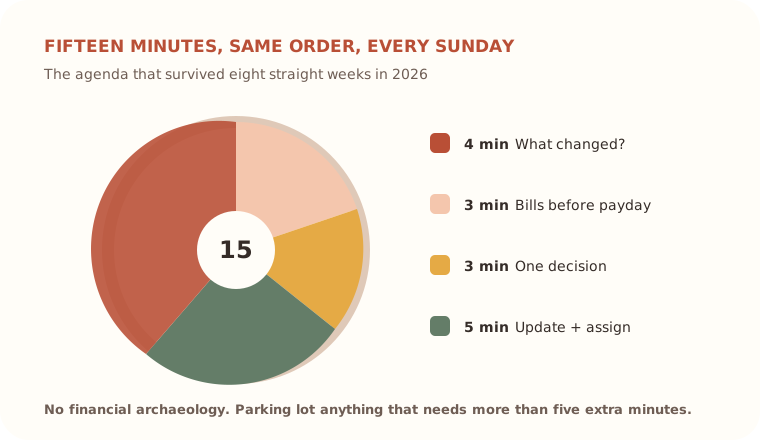
Our weekly money meeting finally lasted because it ends after fifteen minutes. Every Sunday at 7:15 p.m., we answer four questions: what changed, which bills land before payday, what single decision is needed, and who updates what. Across eight meetings from June 14 to August 2, 2026, we averaged 13 minutes and missed none.
Why our previous meetings failed
“We should talk about money” is not an appointment or an agenda. Our old version began when one person noticed a problem and the other person was doing something else. It mixed transaction cleanup, long-term goals, forgotten purchases, and mild accusations. A forty-minute review might be thorough once; it was not repeatable on a tired week.
Monthly meetings failed for the opposite reason. Too much had happened. We spent the first half reconstructing why a category changed and the second half rushing decisions. By the time the next meeting arrived, neither adult remembered who had agreed to cancel the free trial or move the school payment.
The four-question agenda
We wrote the agenda on an index card on June 14. The first four minutes answer “What changed?” We mention income, refunds, unusual spending, and incorrect transactions. This is a change log, not an invitation to narrate every coffee.
The next three minutes cover bills due before the following payday. We read the date and amount, then confirm the paying account. The third section gets three minutes and exactly one decision: increase groceries by $25, approve a registration, delay a purchase, or choose which category absorbs an overage. The final five minutes are for updating totals and assigning the next action.
| Date | Minutes | One decision | Action owner |
|---|---|---|---|
| June 14 | 15 | Set $75 note threshold | Maya |
| June 21 | 12 | Move $40 to school | Daniel |
| June 28 | 14 | Return duplicate supplies | Maya |
| July 5 | 11 | Trim app alerts | Daniel |
| July 12 | 15 | Choose fall activities | Both |
| July 19 | 13 | Plan grocery test | Priya checked data |
| July 26 | 12 | Delay home purchase | Daniel |
| August 2 | 12 | Start school sinking fund | Maya |
| Average | 13 | Eight decisions made | Eight named actions |
The rules around the agenda
First, the meeting is not financial archaeology. We do not investigate a $9 purchase from three weeks ago unless it affects a current balance. Second, either adult can put a topic in the parking lot. A parked issue receives a named time or disappears; it does not become a threat hanging over next Sunday.
Third, we use the same source numbers. During this test, that was Honeydue for shared transactions plus one sinking-fund total. If an account connection lagged, the bank balance won. Our Honeydue review explains why a shared feed helped, but paper works if both people accept the starting figures.
Fourth, no meeting begins with “you always.” The useful unit is a current transaction, bill, category, or choice. This is less about politeness than accuracy. A sweeping claim cannot be reconciled, assigned, or scheduled.
The week the timer felt ridiculous
On July 12, fall activities required a larger discussion. Soccer, gymnastics, piano, and art touched money, transport, identity, and the children’s preferences. Pretending to solve it in three minutes would have made the timer a gimmick. We used the meeting to decide only the next step: calculate the full price and talk with the children that afternoon.
The separate conversation lasted 34 minutes. It produced the keep-cut-swap plan in our children’s activity cost breakdown. The weekly meeting still ended at fifteen. Protecting the small habit made room for the large conversation instead of swallowing it.
What changed after eight weeks
Our average meeting fell from 31 minutes during the first Honeydue week to 13 minutes across this eight-week agenda. More important, every meeting ended with one recorded decision. Seven of eight assigned actions were completed by the following Sunday; the eighth, a refund follow-up, carried forward once.
We did not become perfectly aligned. Maya prefers more category detail; I prefer fewer corrections. The meeting does not eliminate that difference. It gives it a predictable container, and predictable containers are underrated in family finance.
Copy our fifteen-minute version
Pick a weekly time attached to something that already happens. Put balances, bills, and category totals in one view before the timer starts. Ask what changed for four minutes, what is due for three, what one decision is needed for three, and who will update or act for five. Write the decision and owner in one sentence.
After four weeks, remove anything that becomes performance. If reviewing every category never changes a choice, stop doing it. If both adults need more planning structure, see our Goodbudget envelope review. If you are still choosing a shared tool, use the four-week budgeting-app test. The agenda matters more than the software.
FAQ
When should couples hold a weekly money meeting?
Choose a repeatable low-conflict time before the next spending week. We use Sunday at 7:15 p.m., after cleanup and before either adult is too tired.
What if a money issue takes longer than fifteen minutes?
Record it in a parking lot and schedule a separate conversation. The weekly meeting should preserve the habit, not force every large decision into a small window.
Do couples need a budgeting app for the meeting?
No. A current bank balance, upcoming bill list, and paper category totals are enough. An app helps only when both adults trust the same numbers.